


ℹ️ Affiliate Disclosure: This article may contain affiliate links. We may earn a commission at no extra cost to you. Thanks for your support! ❤️
Font Licensing Explained: The Costly Mistake Many Make
A few days ago, I came across a Reddit discussion about font licensing that made me stop for a moment.

A designer was talking about a licensing quote that reportedly reached tens of thousands of dollars per year for a font being used on a website.
At first, I assumed there had to be some missing context.
Most people still think about fonts as a simple purchase.
You buy the font.
Install it.
Use it in your logo, website, graphics, or brand materials.
That feels logical.
But typography does not always work that way legally. And after reading through the comments from designers, agency owners, developers, and business owners, it became clear that font licensing is one of those design details many people only notice when something goes wrong.
For anyone running a website, blog, online store, or small brand, this is worth understanding before a font becomes an expensive problem.
The Mistake Many Website Owners Make
The most common mistake is assuming that buying a font gives you permission to use it everywhere.
In reality, many typefaces have separate licenses for different uses, such as:
- Desktop design work
- Website embedding
- Mobile apps
- Ebooks
- Paid advertising
- Logos and brand identity
- Products for sale
This matters because a font used inside a Photoshop mockup is not always licensed the same way as a font loaded on a live website.
From a web design perspective, this is where people often get caught. A typeface may look perfect in a brand concept, with strong letterforms and the right visual tone, but if the webfont license is unclear or based on traffic levels, it can become difficult to manage once the site grows.
Some foundries price webfont licenses by page views, traffic volume, or company size.
For a large corporation, that may be expected.
For a small business, blog, or creator brand, it can feel like a surprise bill waiting in the background.
Why More Creators Are Looking for Simpler Licensing
One thing I noticed in that Reddit discussion was that many designers were not simply looking for the cheapest fonts.
They wanted licensing they could actually understand.
That matters.
When I choose typography for a website or visual identity, I care about readability, hierarchy, brand personality, and long-term consistency. But I also care about whether the font can realistically support the whole brand system.
A font may look impressive on its own but struggle once it is used across a website, logo, social graphics, PDFs, and digital products.
Licensing is part of that practical reality.
This is one reason platforms like Google Fonts and Creative Fabrica have become popular with bloggers, Etsy sellers, small businesses, and independent creators.
The appeal is not only visual variety.
It is predictability.
Why I Often Recommend Google Fonts First
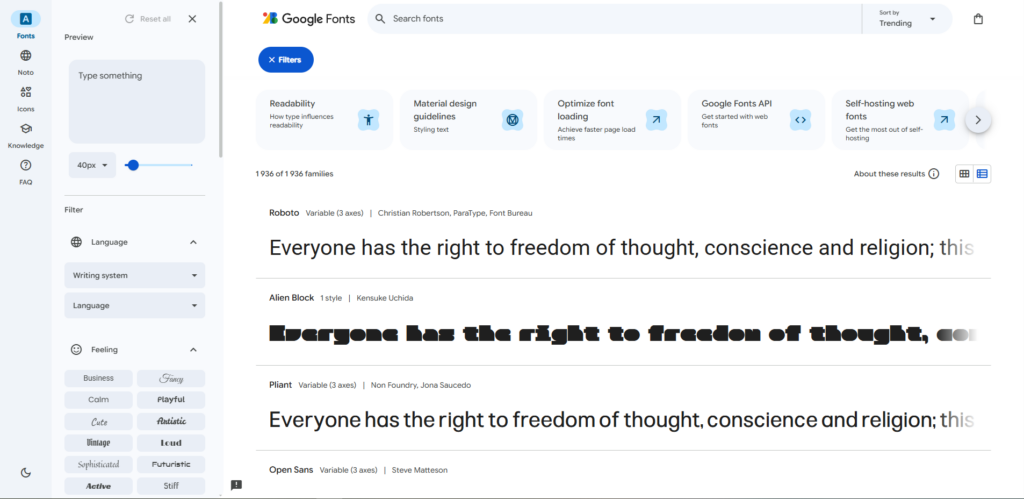
If someone asks me for a safe starting point for website typography, I usually suggest Google Fonts first.
Not because every Google Font is perfect.
Some are overused. Some have limited personality. Some need careful pairing to avoid looking generic.
But for website use, the licensing is straightforward, implementation is simple, and there are no unexpected traffic-based costs as the site grows.
Fonts like Inter, Montserrat, Poppins, Nunito, and Roboto are used widely for a reason. They are readable, flexible, and dependable in digital interfaces.
For many websites, that matters more than choosing the most distinctive typeface.
Good typography is not always about standing out loudly. Often, it is about making content feel clear, trustworthy, and easy to read.
Creative Fabrica and Commercial Use Fonts
Google Fonts is practical, but it does not cover every branding need.
Sometimes a project needs something more expressive: a script font, a decorative display font, a vintage typeface, a handmade style, or a more niche branding font.
This is where Creative Fabrica can be useful for creators who want more variety without dealing with overly complicated traditional licensing structures.
I would still read the license before using any font commercially.
That is always the rule.
But for bloggers, small businesses, product creators, and social media brands, having access to a large library of commercial-use fonts can make the design process easier.
The key is to choose carefully.
Many decorative fonts look attractive in a preview image but become difficult to use in real branding. Some have tight spacing, awkward kerning, or letterforms that lose clarity at smaller sizes.
A display font may be strong for a logo or headline, but weak for website body text.
That distinction matters.
Making sure you understand font licensing can save you from costly mistakes, allowing you to confidently choose the perfect typography for your projects, such as exploring Fashion Boutique Logo Fonts: 12 Elegant Picks to elevate your brand.
The Lesson I Took Away From That Reddit Post
The biggest lesson was not that premium fonts are bad.
Many premium typefaces are excellent. A well-built typeface can give a brand more personality, better recognition, and a more refined visual identity.
The lesson is that every font comes with rules.
Before using a font on a website, inside a logo, or across a brand system, it is worth asking one simple question:
Do I fully understand the license?
That five-minute check can save a lot of stress later.
Typography shapes how a brand feels.
Licensing determines whether you can actually use that typography safely.
Both matter.
Frequently Asked Questions
Can I use a purchased font on my website?
Not always. Many fonts require a separate webfont license for website use. Buying a desktop license does not automatically allow you to use the font on a website.
What's the difference between a desktop font license and a webfont license?
A desktop license allows you to install and use a font on your computer for design projects. A webfont license covers the use of that font on a live website where visitors access the font through their browsers.
Are Google Fonts free for commercial use?
Yes. Most Google Fonts are open-source and can be used for commercial projects, websites, branding, and client work without additional licensing fees.
Can I use a font in a logo?
In most cases, yes. However, some font licenses include restrictions regarding logos, trademarks, or commercial branding, so it's important to review the license terms before use.
What happens if I use a font without the correct license?
You may be required to purchase the proper license, remove the font, or pay additional fees. In some situations, copyright infringement claims may result in legal action.
Follow Us