

AI-Generated Logos Are Fast — But They Often Feel Familiar
AI generated logos have become one of the fastest ways to create a brand identity today. After reviewing hundreds of AI-generated logos across different industries, I've noticed the same problem appearing again and again: many of them look surprisingly similar.
Some links in this article may be affiliate links. If you purchase through them, we may earn a small commission at no extra cost to you. Thanks for supporting our work.
I completely understand the appeal.
For startups, side projects, creators, and small businesses working with limited budgets, AI tools remove a lot of the barriers that traditionally came with branding.

The problem is that after reviewing hundreds of AI-generated logos across different industries, a pattern becomes hard to ignore:
A surprising number of them look almost the same.
They may be clean. They may be modern. They may even look professional at first glance.
But many lack the distinctiveness that helps a brand stay memorable.
So why does this happen?
The answer isn't that AI is bad at design. It's that AI approaches design very differently from a human designer, and those differences naturally lead to more generic outcomes.
How AI Logo Generators Actually Create Designs
AI Learns From Existing Visual Patterns
One of the biggest misconceptions about AI logo design is that AI creates ideas from pure creativity.
It doesn't.
AI models learn from enormous collections of existing logos, branding systems, icons, typography, illustrations, and design assets. Their strength comes from identifying relationships and patterns within that data.
When you enter a prompt, the system isn't imagining something completely new.
Instead, it's predicting what design elements are most likely to match the request.
That's a subtle but important distinction.
Human designers often start with research, conversations, observations, and strategy. AI starts with probability.
Probability can create attractive designs.
But it rarely creates unexpected ideas.
Most Users Give Similar Instructions
Another reason AI-generated logos often end up looking alike has nothing to do with the technology itself.
It comes from the prompts.
Think about how people typically describe the logo they want:
- Modern
- Professional
- Minimalist
- Premium
- Clean
- Innovative
These words show up everywhere.
The challenge is that they're also incredibly broad.
If thousands of businesses ask for a “modern minimalist logo,” AI naturally begins producing similar visual solutions.
The output reflects the input.
And generic prompts often lead to generic branding.
The Convergence Problem
AI Naturally Moves Toward Familiar Solutions
In design, there's a phenomenon that frequently appears in AI-generated work: convergence.
The idea is simple.
Different requests gradually produce similar results because the system keeps returning to patterns that have worked before.
I've noticed this repeatedly across industries.
Technology companies receive:
- Abstract geometric marks
- Hexagons
- Network-inspired symbols
Finance brands receive:
- Shields
- Checkmarks
- Blue color palettes
Healthcare companies receive:
- Crosses
- Leaves
- Circular wellness icons
Marketing agencies receive:
- Growth arrows
- Connected nodes
- Abstract graphs
None of these elements are inherently bad.
The problem is that they've become so common that they rarely communicate anything unique.
Safe Designs Usually Win
AI systems are optimized to satisfy expectations.
That helps prevent obviously poor design choices.
But it also creates a side effect.
Safe ideas become dominant.
Safe ideas become familiar.
And familiar ideas rarely become memorable brands.
The logo may look polished enough for a website header, but it doesn't necessarily create recognition.
Creativity and Prediction Are Not the Same Thing
AI Predicts. Designers Create.
Human designers create ideas.
AI predicts ideas.
That difference explains much of the gap between generic logos and distinctive branding.
AI doesn't truly understand:
- Why a company exists
- What customers care about
- Internal culture
- Competitive positioning
- Long-term goals
It can analyze patterns associated with those concepts, but it doesn't actually understand them.
A designer, on the other hand, might spend hours researching a business before opening Illustrator.
They'll study competitors.
They'll analyze customer expectations.
They'll identify opportunities for differentiation.
Often, the strongest logo concepts come from those discoveries rather than from visual trends.
A Logo Is Only One Piece of Branding
This is another area where AI-generated logos are often misunderstood.
Many people think branding equals logo design.
It doesn't.
The strongest brands are built around a complete identity system that includes:
- Messaging
- Brand voice
- Typography
- Color strategy
- Visual hierarchy
- Customer experience
- Positioning
The logo is simply one component.
Without strategic context, even a beautiful logo can feel disconnected from the business behind it.
Why Design Trends Make AI Logos Look Even More Similar
Minimalism Has Dominated Branding for Years
Modern branding has leaned heavily toward simplicity.
As a result, AI models have learned enormous numbers of examples featuring:
- Flat design
- Simple geometry
- Sans-serif typography
- Thin iconography
- Limited color palettes
These trends exist because they solve real design problems.
They're scalable.
They're readable.
They're versatile.
But when every system learns from the same trends, visual repetition becomes almost unavoidable.
Some Symbols Are Everywhere
After reviewing enough AI-generated logos, certain motifs become impossible to miss.
You start seeing:
- Infinity symbols
- Generic swooshes
- Abstract circles
- Stylized initials
- Geometric monograms
Sometimes they're executed well.
Sometimes they're not.
Either way, they often feel interchangeable because so many brands already use similar ideas.
The Missing Ingredient: Strategic Context
AI Doesn't Know Your Story
Even the most advanced logo generator doesn't know:
- Why you started your company
- What problem you're solving
- What motivates your customers
- What makes your approach different
It only knows what you tell it.
And most prompts contain a tiny fraction of the information a human designer would gather during a discovery process.
That's a major limitation.
The details that make brands unique are often hidden inside customer conversations, founder insights, industry knowledge, and lived experience.
Those nuances rarely fit inside a one-sentence prompt.
Storytelling Creates Memorable Brands
Many iconic logos contain subtle layers of meaning.
Sometimes it's symbolism.
Sometimes it's history.
Sometimes it's a visual reference that customers don't notice immediately.
Those ideas usually emerge through exploration and intentional design decisions.
They're difficult to generate through prediction alone.
Common Problems I Notice in AI-Generated Logos
They Blend Into the Crowd
The most common issue is simple.
Many AI-generated logos look like they belong to somebody else.
Not because they're copied directly.
But because they rely on the same visual language used by thousands of brands already.
That makes differentiation much harder.
Trademark Risks Can Appear
When designs are built from heavily repeated patterns, similarity becomes a concern.
Businesses should always conduct proper trademark research before adopting an AI-generated logo commercially.
A logo that looks unique to you may resemble something that already exists in the market.
Real-World Applications Reveal Weaknesses
I've seen logos that look fantastic inside a logo generator preview and much less impressive once they're applied elsewhere.
Some struggle on:
- Packaging
- Business cards
- Mobile apps
- Merchandise
- Social media avatars
A strong logo has to survive beyond the presentation screen.
That's where many AI-generated concepts start showing limitations.
Can AI Create Good Logos?
Absolutely — If You Use It Correctly
Despite the criticism, AI can be genuinely useful.
In fact, after reviewing countless AI-generated logos, I've found that the biggest advantage isn't getting a finished logo.
It's getting past the blank-page problem.
AI can help you:
- Explore visual directions quickly
- Generate mood board ideas
- Visualize concepts
- Test styles
- Discover unexpected combinations
For early-stage projects, that's incredibly valuable.
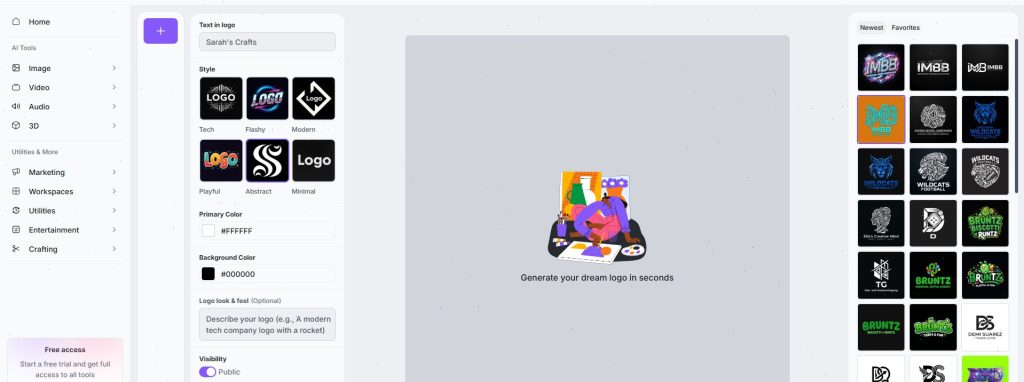
If you're still exploring branding ideas, tools like Creative Fabrica's AI Logo Generator can be a practical place to start. Instead of sketching concepts from scratch, you can generate multiple logo directions in seconds, experiment with different styles, and see how various visual approaches might fit your business. The platform allows you to describe your niche, brand personality, preferred colors, and even taglines before generating concepts, which often produces more relevant results than basic prompts.
What I like is that it encourages experimentation.
You don't have to commit to the first result.
You can generate several directions, compare them, identify recurring ideas you like, and build from there.
For entrepreneurs, creators, and small businesses that aren't ready to hire a branding agency, that's often enough to discover a promising direction before investing more heavily in design work.
Human Refinement Is Usually What Makes the Difference
The strongest results often come from combining AI speed with human judgment.
A designer can take a promising AI concept and improve:
- Typography
- Proportions
- Symbolism
- Visual balance
- Brand alignment
That's usually where a generic logo starts becoming a genuine brand asset.
I've seen this process work particularly well when AI is used for brainstorming and exploration, while the final refinement focuses on readability, spacing, originality, and positioning.
The AI handles speed.
The human handles strategy.
How to Make an AI-Generated Logo Feel More Unique
Give the AI Better Information
The quality of the prompt matters far more than many people realize.
Instead of:
Create a modern business logo.
Try describing:
- Your audience
- Your values
- Your industry
- Your personality
- Your positioning
The extra detail gives AI much more context to work with.
For example, instead of asking for a modern fitness logo, explain that you're building a premium strength coaching brand focused on busy professionals in their 30s and 40s who value long-term health over quick transformations.
That level of specificity often produces dramatically better results.
Define Brand Personality Clearly
Words like:
- Adventurous
- Sophisticated
- Playful
- Bold
- Trustworthy
- Curious
provide stronger direction than generic business language.
The more specific the personality, the more distinctive the visual direction tends to become.
Don't Accept the First Version
This might be the simplest advice of all.
The first logo generated by AI should rarely be the final logo.
Experiment.
Edit.
Refine.
Change fonts.
Adjust spacing.
Rework symbols.
Small adjustments often make a bigger difference than people expect.
What the Future of AI Logo Design Might Look Like
AI tools are improving quickly.
Future systems will likely incorporate:
- Better personalization
- Competitive analysis
- Customer insights
- Brand-specific training data
As those capabilities evolve, AI-generated logos will almost certainly become more sophisticated.
But even with better technology, branding remains deeply human.
People connect with stories.
They connect with meaning.
They connect with brands that feel authentic.
That's why strategic thinking and creative judgment will continue to matter, no matter how advanced AI becomes.
Understanding why AI often produces similar-looking logos is a great first step, and you can further refine your approach by learning about AI Logo Design Mistakes: 10 Costly Beginner Errors That Hurt Your Brand.
Final Thoughts
AI-generated logos often look generic because they're built on prediction, patterns, and probability.
That's not necessarily a flaw.
It's simply how the technology works.
AI is excellent at producing polished concepts quickly. What it struggles with is differentiation, storytelling, and the deeper strategic thinking that helps brands become memorable.
The businesses getting the best results today aren't choosing between AI and human designers.
They're using both.
AI provides speed and inspiration.
Human creativity provides direction, meaning, and originality.
And that's usually where the strongest brand identities emerge.
Frequently Asked Questions
Why do AI-generated logos look similar?
Because AI models learn from large collections of existing logos and design trends. When similar prompts are entered repeatedly, the generated results often converge toward the same visual patterns.
Are AI-generated logos unique?
Some can be unique, but many share similarities because they rely on common design conventions found throughout their training data.
Can AI replace logo designers?
AI can help generate ideas and speed up the creative process, but human designers still provide strategy, storytelling, brand positioning, and originality.
Should startups use AI logo generators?
For many startups, AI logo generators can be a useful and affordable way to explore branding ideas during the early stages of business development.
How can I make an AI-generated logo stand out?
Use highly detailed prompts, customize the design extensively, test it across real-world applications, and refine it with human design expertise whenever possible.

Follow Us